Why concrete cracks on Blackland clay — and how to build so it doesn't
The expansive soil east of I-35 explains most of the broken driveways in Williamson County. Here's the mechanism and the fix.
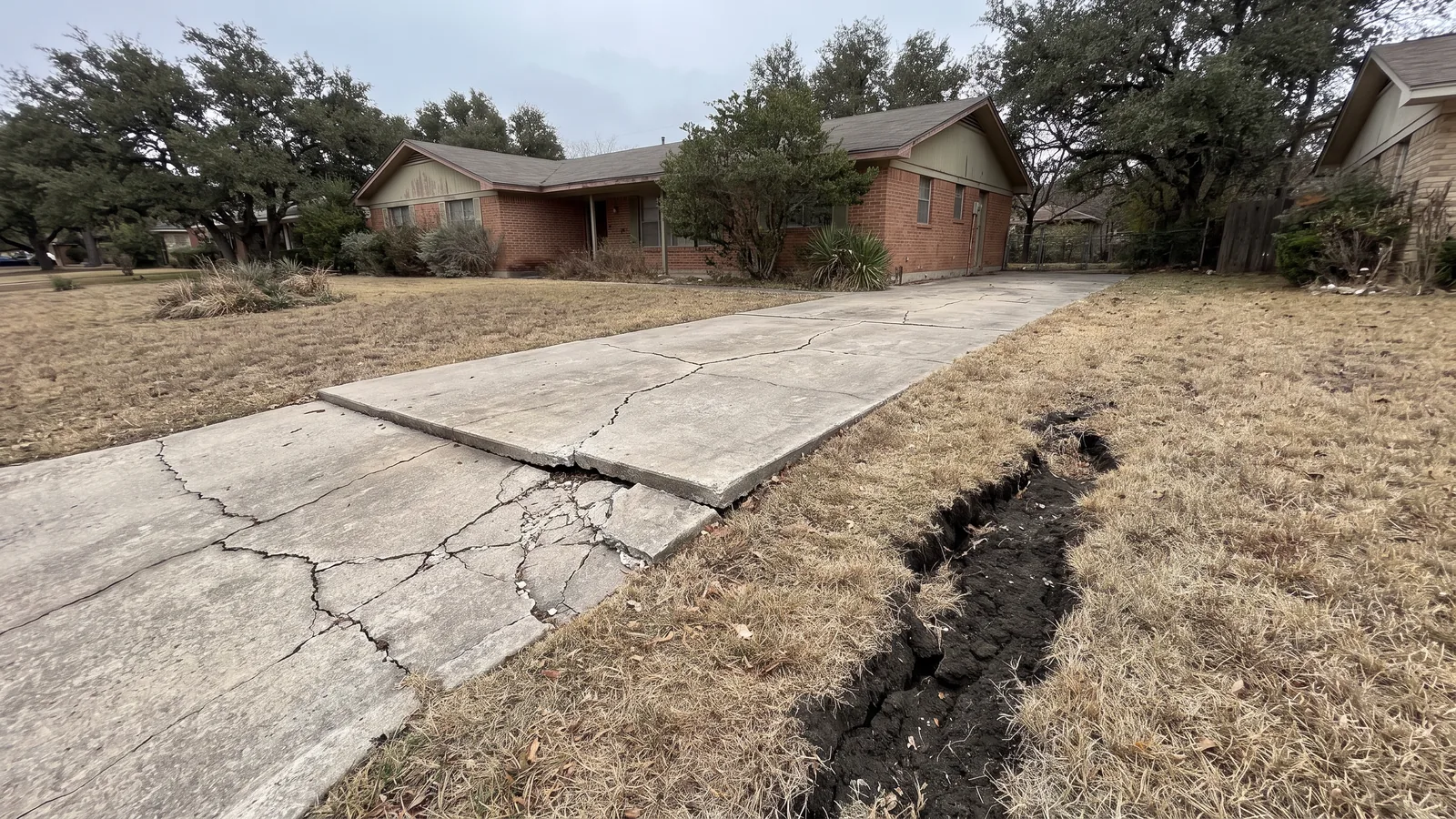
Georgetown sits on the Balcones fault. West of I-35 the ground is Edwards limestone and caliche — stable, sometimes too shallow to dig. East of it is the Blackland Prairie: Houston Black clay, a Vertisol that's 45 to 60 percent clay minerals, the most expansive common soil in the country. It swells when it's wet and shrinks when it's dry, by inches, every year. A slab poured on it rides that movement, and unless it's built to, it breaks.
What the clay actually does
In a wet winter the clay under the middle of a driveway stays wet and swells while the edges dry and shrink; the slab humps in the center and cracks along the crown. In a dry summer — 2011, 2022, 2023 — the edges shrink first and the slab cantilevers and cracks at the garage and the approach. Under a patio the same cycle tilts it toward or away from the house. Under a pool deck it drops the deck toward the shell. The builder-grade fix — four inches of concrete on raked clay with wire mesh lying on the ground — has no chance.
How to build on it
Over-excavate and replace the base
Remove 8 to 12 inches of the clay and replace it with select fill or crushed limestone compacted in lifts. The slab then sits on material that doesn't swell, with the clay's movement buffered below.
Moisture-condition what's left
Clay that's wetted to near its plastic limit before the base goes down moves less afterward than dry clay that swells with the first rain.
Rebar on chairs, not mesh on the ground
#3 bars 18 inches on center, held in the middle of the slab, so when the slab cracks — it will — the pieces stay locked together and level.
Joints that let it move
Control joints at 10 to 12 feet so the cracks happen where they're cut; expansion joints against the garage slab, the sidewalk and the pool, so the driveway doesn't pry on the foundation.
Thicker where it's loaded
Six inches at the approach and anywhere a truck turns.
Control the water
Gutters and downspout extensions away from the slab; irrigation heads that don't spray the driveway edge; grading that sheds water. The clay only moves when its moisture changes — keep it steady and everything lasts longer.
Fixing what's already cracked
| Fix | Price | When |
|---|---|---|
| Polyurethane foam lifting | $600 – $3,000 | Slab in large sound pieces, sunk or tilted; done in a morning |
| Crack routing and flexible filler | $250 – $900 | Stable cracks; keeps water out of the base |
| Section replacement | $16 – $24 / sq ft | One broken panel in a sound driveway |
| Full replacement on an engineered base | $10 – $14 / sq ft | Cracked into pieces, heaved at the garage, dropped at the approach |
| Drainage and irrigation fixes | $150 – $1,200 | Always — before or with any of the above |
Which side are you on?
Roughly: I-35 is the line. Teravista, Berry Creek, La Conterra, Saddlecreek, east Round Rock, all of Hutto and Sonterra are clay. Wolf Ranch, Sun City, Water Oak, Parkside, Leander, Cedar Park and Liberty Hill are limestone. Near the line it's mixed, and we probe on the estimate.
Common questions
Can a driveway on clay ever last?
Yes — the roads and the commercial lots on the east side last because they're built on stabilized subgrade. A residential driveway built the same way, with a replaced base, rebar and joints, lasts 25 to 30 years.
Is foam leveling a good fix on clay?
Good for a slab in large sound pieces — the foam is waterproof and doesn't wash out — and it's a morning's work. It doesn't stop the clay from moving, so keep the water steady. A slab broken into small pieces should be replaced.
Does the drought crack driveways?
Yes — 2011, 2022 and 2023 broke more Williamson County driveways than any wet year. The clay shrank away from the slab edges and the unsupported slab cracked. Watering the soil around a slab during a drought actually helps, the same as for a foundation.
Why doesn't the builder do it right?
Cost and schedule. A clay-engineered driveway costs $1,500 to $3,000 more than the builder's spec on a production house; the builder's warranty on flatwork is usually a year.
Do I need this on the west side?
No — limestone doesn't move. On the west side the risk is the opposite: shallow rock that has to be broken, and loose builder fill that has to be compacted.
Related: Repair, leveling & replacement · Driveways · Driveway cost guide · Slab thickness guide