Can you pour concrete when it's 100 degrees? Yes — if you do it right
Georgetown pours concrete June through September every year. Here's what hot-weather concreting actually requires, and how to tell if your contractor is doing it.
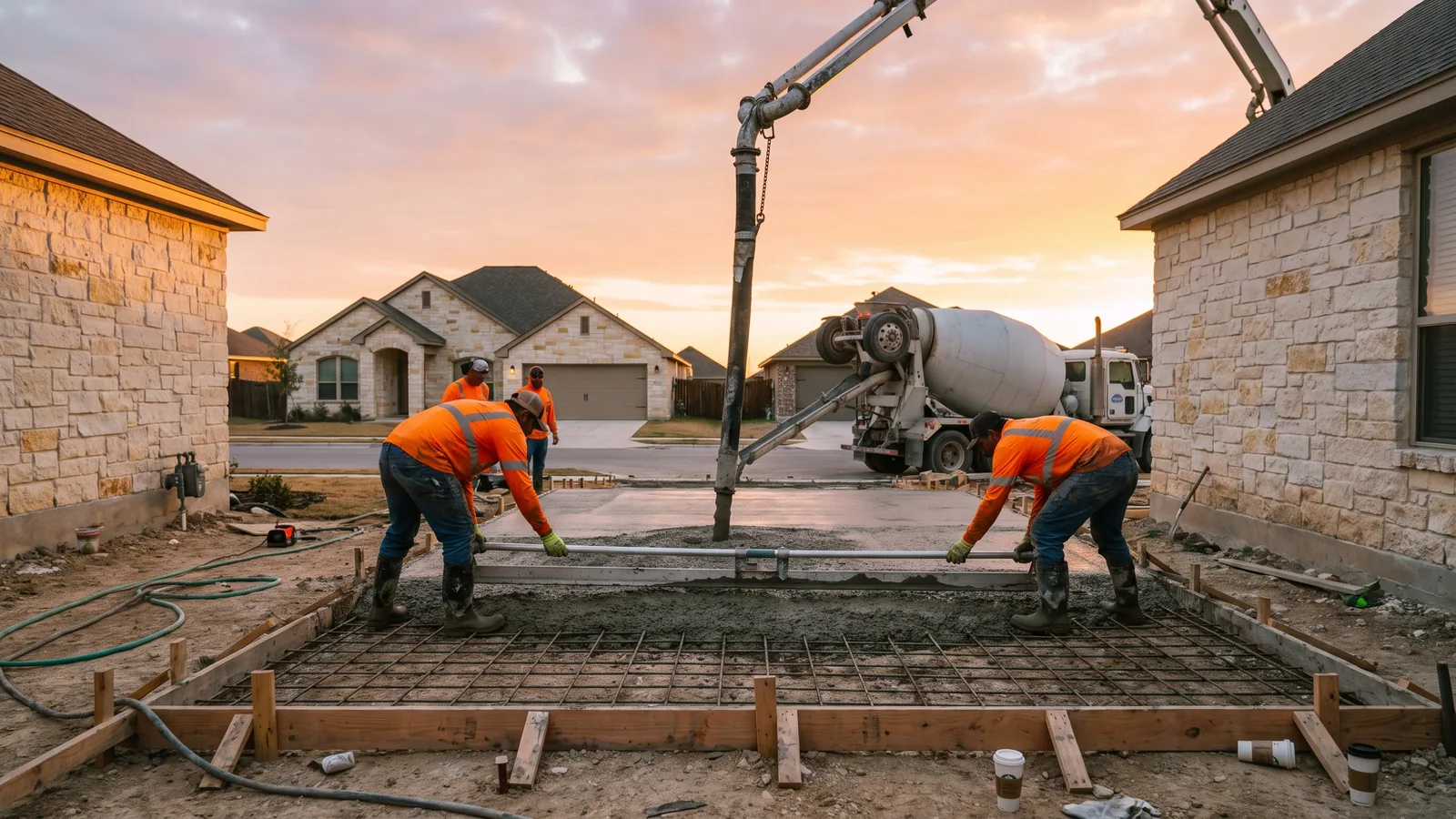
Half of Georgetown's concrete gets poured in months when the afternoon high is over 95, and most of it is fine. The problem isn't heat itself — it's what heat does to fresh concrete when nobody adjusts for it: the mix sets before it's finished, the surface dries faster than the interior and shrinkage-cracks, and the slab never reaches its design strength because it cured dry. Hot-weather concreting is a standard practice with a standard set of fixes, and a contractor who pours here should be doing all of them.
What we do differently from June to September
Start at sunrise
Pours are scheduled to place and finish before the slab surface hits 90 degrees — trucks arrive at 6 or 6:30, we're floating by 9, and we're broom-finishing before noon. Afternoon pours in August are how you get a driveway that crazed on day one.
Adjust the mix
Chilled water or ice in the batch, a set-retarding admixture so the concrete stays workable, and a water-reducer so nobody adds water on site to loosen it — added water on a hot day is the fastest way to a weak, dusting surface.
Wet the base and the forms
Hot dry sand or clay and hot steel forms suck the water out of the bottom of the slab; we dampen everything before the pour.
Cure it wet
The most-skipped step. Concrete needs to stay moist for a week to hydrate; in our heat that means a curing compound sprayed on as soon as the finish will take it, or plastic and wet burlap, or at minimum a daily hose-down for seven days. A slab that dries out in three days has half its strength and a chalky surface.
Watch the wind
A hot south wind pulls water off the surface faster than heat alone; on windy days we fog the surface and finish in smaller sections.
Cut the joints the same day
Shrinkage starts within hours in summer. Control joints are cut or tooled the day of the pour, not the next morning after the crack has already found its own path.
What hot-weather shortcuts look like
A 1 PM pour in July. Water added to the truck to make it easier to spread. No curing compound — the crew leaves at 3 and the slab bakes. Joints cut the next day. A surface that turns dusty in a month. If you're getting quotes for summer work, ask what time they start and how they cure.
Is winter better?
Georgetown winters are mostly ideal — 50s and 60s — with a few freezes to plan around. Concrete shouldn't be poured when it will freeze within 24 hours; we watch the forecast in January and February and pour on the warm days. The best months are March–May and October–November, but there's no reason to wait if it's summer; just make sure it's done right.
Common questions
Is it bad to pour concrete in the summer?
Not if the contractor pours early, adjusts the mix and cures it wet. Georgetown pours thousands of yards every July. It's bad when someone pours at 1 PM, adds water and skips the cure.
Will my new driveway crack in the heat?
It will shrink and crack somewhere — that's what control joints are for, and in summer they need to be cut the same day. Random cracking on a hot pour means the surface dried too fast or water was added.
How long should I water new concrete?
If we've applied a curing compound, you don't need to. If not, hose it down two or three times a day for a week. Keeping it moist is what gives it strength.
Can you pour when it's raining?
No, and we reschedule rather than risk it. A brief shower after the finish has set is fine; rain on fresh concrete ruins the surface.
When is the best time of year to pour concrete in Georgetown?
Spring and fall are easiest. Summer is fine with hot-weather practice. Winter is fine outside of freeze days.
Related: Driveways · Patios & outdoor living · Slab thickness guide