How thick should a concrete slab be — and what should be under and in it?
Thickness, rebar, PSI, base and joints for every residential slab on Williamson County soil.
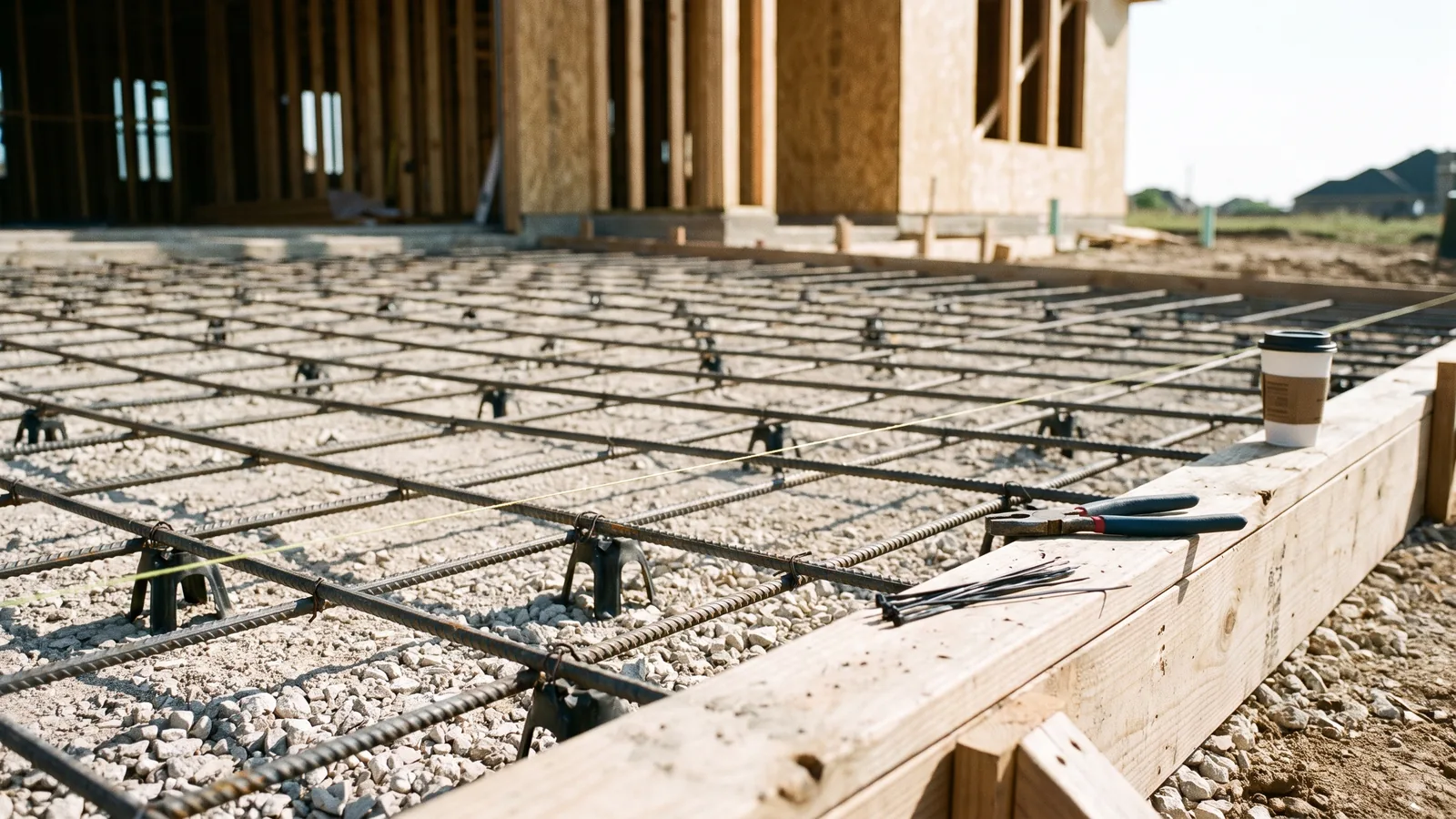
Thickness is what everyone asks about and the least important part of a slab that lasts. Six inches on raked clay heaves; four inches on an engineered base with rebar lasts thirty years. Here's what goes into a slab that holds up here, by project.
Thickness by project
| Slab | Thickness | Reinforcement | Concrete |
|---|---|---|---|
| Walkway, patio, porch slab | 4 in | Fiber + #3 rebar 24 in o.c. on clay; fiber alone on limestone | 3,000–3,500 psi |
| Pool deck | 4 in | #3 rebar 18 in o.c.; expansion joint at coping and house | 3,500 psi |
| Driveway (cars) | 4 in, 6 at the approach | #3 rebar 18 in o.c. on chairs | 3,500 psi |
| RV / boat pad, heavy trucks | 5–6 in | #4 rebar 18 in o.c. | 3,500–4,000 psi |
| Shop / barn slab | 4–5 in, 12×18 thickened edge | #3 in slab, #4 in the edge; per engineer for large spans | 3,500 psi |
| ADU / addition foundation | Per engineer — often post-tension on clay | Engineered | 3,500 psi+ |
| Dumpster pad, dock apron | 8 in | #4–#5 both ways | 4,000 psi |
Reinforcement: rebar, mesh or fiber?
On clay we use rebar in almost everything — #3 bars on chairs in the middle of the slab — because when the slab cracks (it will), rebar holds the pieces level; wire mesh lying on the ground, which is what most builder driveways have, does nothing. Fiber (synthetic macro-fibers in the mix) controls shrinkage cracking and is a good addition, not a substitute for rebar on clay. On limestone, fiber alone is fine for a patio or walk; driveways still get rebar.
PSI
3,000 psi is the residential minimum; we pour 3,500 on driveways and decks because it has less water in it and cracks less, and 4,000 on commercial and heavy pads.
The base — the actual answer
East of I-35: over-excavate 8 to 12 inches of clay and replace with select fill or crushed limestone compacted in lifts. West of I-35: compact the native limestone fines, and break rock where it's too shallow; never pour on the loose fill builders leave. Slabs are pitched an eighth inch per foot away from the house. A vapor barrier goes under slabs that will be enclosed or coated; not under a driveway.
Joints
Control joints a quarter of the depth, cut or tooled the day of the pour, spaced at 24 to 30 times the thickness — 10 to 12 feet for a 4-inch slab. Expansion joints against the foundation, the sidewalk, the pool and any other slab. On clay the expansion joints are what keep the driveway from prying on the house.
Post-tension slabs
Most Central Texas houses on clay sit on post-tensioned foundations — steel cables tensioned after the pour to hold the slab in compression. Additions and ADUs on the east side usually need the same, designed by an engineer; a shop or barn generally doesn't. We coordinate with the engineer and the PT contractor when a project calls for it.
Common questions
Is a 4-inch driveway enough in Texas?
For cars, yes — 4 inches of 3,500-psi concrete with rebar on an engineered base, 6 inches at the approach. It's the base and the rebar that make it last, not an extra inch of concrete.
Rebar or mesh?
Rebar, on chairs, every time on clay. Mesh only works if it's held mid-slab, and it almost never is.
How thick for a shop slab?
Four inches with a 12-by-18 thickened edge for a typical 30-by-40 metal building; five inches if you'll park a truck or lift in it. Large spans and mezzanines go to an engineer.
Do I need a post-tension slab for an ADU?
On the clay side, usually yes — the engineer will specify it. On limestone a conventional reinforced monolithic slab is common.
What PSI for a patio?
3,000 is fine; 3,500 is a small upcharge that cracks less in our heat.
Related: Slabs, shops & foundations · RV & boat pads · Driveways · Why concrete cracks on clay